Campaign basics
A campaign is the top-level container for notes, sessions, NPCs, locations, maps, items, characters, party records, and questlines.
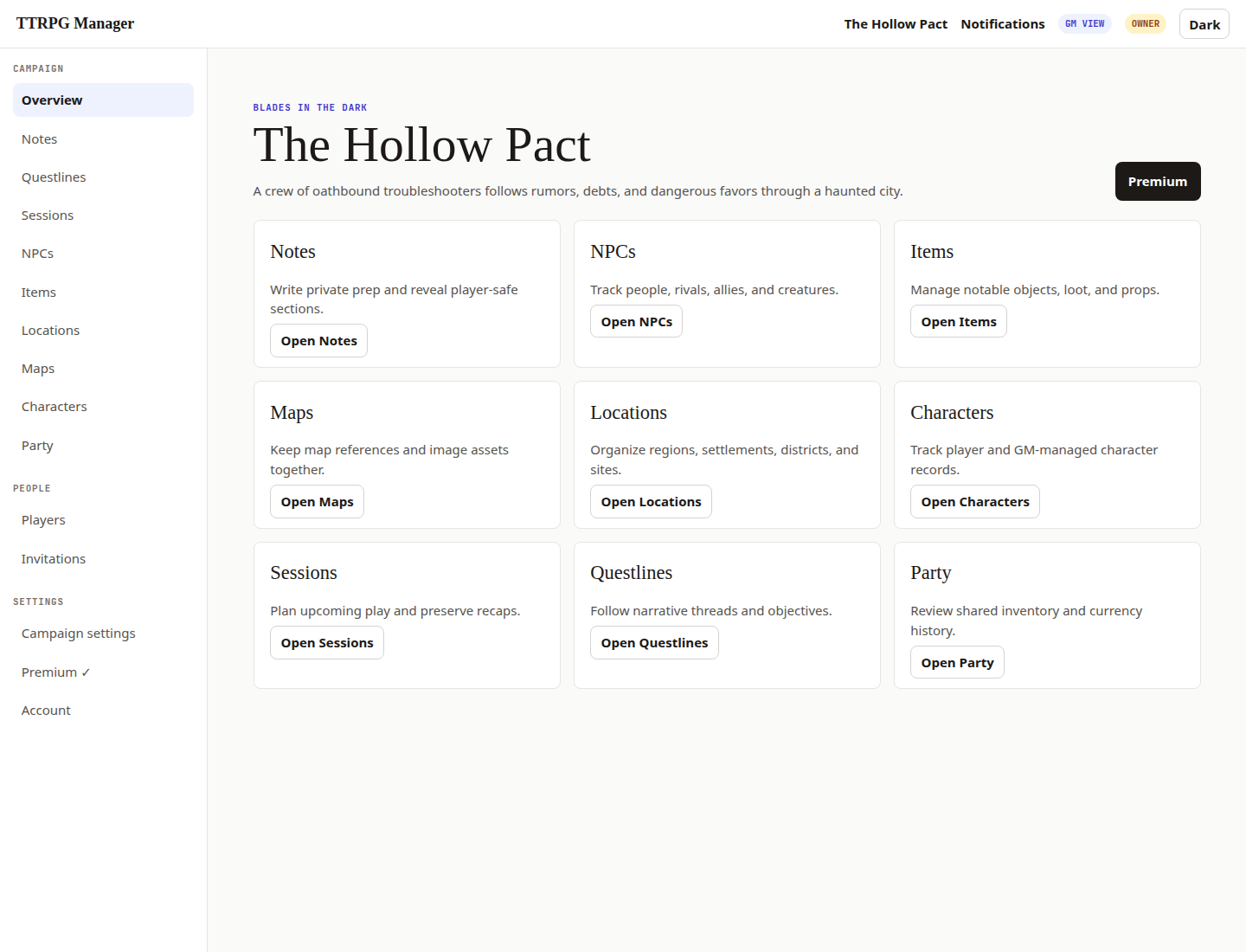
What belongs in a campaign
Use a campaign for anything the table may need to remember later:
- Prep that only GMs should see.
- Player-facing recaps and reference material.
- People, places, objects, maps, and characters.
- Party resources, questlines, and session history.
Main workspace sections
| Section | Use it for |
|---|---|
| Notes | Private prep, player-facing handouts, theories, clues, and reveal-by-section writing. |
| NPCs | Allies, rivals, contacts, factions, monsters, and recurring named presences. |
| Items | Loot, clues, props, keys, artifacts, resources, and notable objects. |
| Maps | Reference images that players can zoom and pan when the record is visible. |
| Locations | Regions, settlements, districts, rooms, sites, and other places. |
| Characters | Player and GM-managed character records, sheet links, PDFs, and relationships. |
| Sessions | Upcoming agendas, private prep, played recaps, and follow-up notes. |
| Questlines | Active threads, objectives, open questions, and story status. |
| Party | Shared inventory and the campaign currency ledger. |
System labels
The system label is descriptive. It helps the table remember what they are playing, but it does not change the core app behavior.
Use any label that makes sense to the group. A campaign can be Mothership,
Cairn, D&D 5e, Homebrew, or anything else.
Campaign roles
Owners manage invitations, roles, billing, and ownership transfer. GMs manage campaign content. Players see the material that has been shared with them.
Ownership is about account and billing control. GM and player roles are about what someone can do inside the campaign.
Visibility as the organizing rule
Visibility is the reason to keep campaign material here instead of only in a general-purpose notes app. A campaign record can start as private prep, become visible to every player, or be shared with selected players when a secret belongs to one character. Hidden content is absent from player view instead of replaced with spoiler-shaped placeholders.
Not a virtual tabletop
TTRPG Manager is for the campaign memory around play: prep, recaps, references, assets, and player-safe reveals. It is not a tactical grid, voice room, live cursor space, marketplace, or rules engine for every system. Use it beside your table, VTT, notebook, or chat tool when the story needs one durable source of truth.